
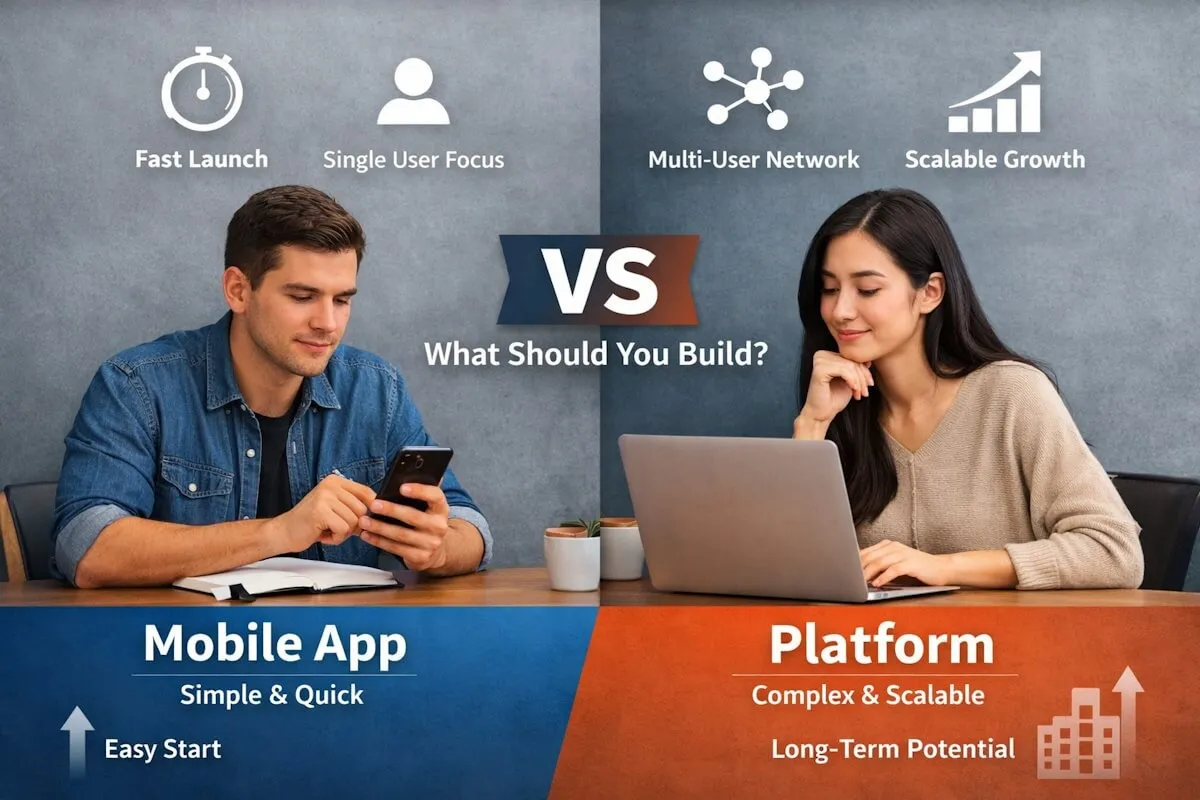
At some point, every product team faces this question.
Should we build a mobile app… or a platform?
It sounds like a technical decision. It’s not.
This choice shapes how your business grows, how users interact with you, and how revenue flows in.
Pick the wrong direction, and you might spend months building something that doesn’t scale the way you expected.
Let’s break it down in a simple, practical way.
First, What’s the Real Difference?
A mobile app is usually focused.
It solves a specific problem for a specific group of users.
Think of:
- A fitness tracking app
- A food delivery app
- A note-taking app
Clear purpose. Clear flow.
A platform is different.
It connects multiple user groups.
- Buyers and sellers
- Service providers and customers
- Creators and audiences
It’s more like an ecosystem than a single solution.
So the real question is not “Which one is better?”
It’s “What are you trying to build?”
If You Want Speed, Apps Are Easier to Launch
Apps are simpler to start with.
You focus on one user type. One main problem.
Less complexity. Faster development.
If you want to test an idea quickly, an app is usually the better choice.
You can launch faster, gather feedback, and improve.
Platforms take longer.
You need to think about both sides of the system from day one.
That slows things down.
Platforms Are Harder, But They Scale Differently
Platforms are not easy to build.
You’re not just building features. You’re managing interactions between users.
You need:
- Matching systems
- Payment flows
- Trust mechanisms
- Moderation
It’s more work.
But if it works, it scales in a different way.
More users attract more users.
That’s where platforms grow faster over time.
The Chicken-and-Egg Problem
Platforms come with a challenge.
You need both sides to make it work.
No sellers? Buyers don’t come.
No buyers? Sellers don’t stay.
This is one of the biggest hurdles.
Apps don’t have this problem.
You can focus on delivering value to one group first.
That’s why many companies start with an app and expand into a platform later.
Revenue Models Are Different
Apps usually have straightforward monetization.
- Subscriptions
- In-app purchases
- Ads
Platforms have more options.
- Commission on transactions
- Listing fees
- Premium access
But they also require more setup.
Payments, disputes, trust systems.
It’s not just about earning money. It’s about managing it across users.
Complexity Increases Fast With Platforms
An app can stay simple for a long time.
A platform rarely does.
As more users join, complexity increases.
- More edge cases
- More interactions
- More support needs
You need stronger systems to handle this.
If you’re not prepared, things can get messy.
User Experience Is Easier to Control in Apps
With apps, you control the experience.
You design the flow. You guide the user.
With platforms, users interact with each other.
That adds unpredictability.
You can guide the system, but you can’t control every interaction.
This makes UX design more challenging.
Maintenance Effort Is Different
Apps require regular updates, but they’re easier to manage.
Platforms need constant monitoring.
You’re not just maintaining code. You’re managing a system of users.
Issues can come from user behavior, not just technical problems.
That adds another layer of responsibility.
So, What Should You Build First?
Here’s a practical way to think about it.
Start with an app if:
- You’re solving a clear problem
- You want to launch quickly
- You’re testing an idea
- You have one main user group
Consider a platform if:
- Your idea depends on connecting users
- You have a plan to handle both sides
- You’re ready for more complexity
- You’re thinking long-term scale
In many cases, starting with an app is the safer path.
You build traction first. Then expand.
The Role of the Right Development Strategy
The choice between app and platform is not just about features.
It’s about execution.
Working with a Mobile App Development Company can help you structure your product in a way that supports future growth, whether you start with an app or move toward a platform later.
And if you want flexibility as your product evolves, you might choose to Hire Mobile App Developers who can adapt your system as your needs change.
Because what you build today might not be what you need tomorrow.
One Honest Reality
Trying to build a full platform too early can slow you down.
Trying to stay too small for too long can limit your growth.
The balance matters.
Ask Yourself This Before Deciding
- Do we need multiple user groups from day one?
- Can we deliver value with a simpler app first?
- Are we ready to handle platform complexity?
Your answers will guide your decision.
Final Thought Before You Build
You don’t have to choose once and stick with it forever.
Many successful products start as simple apps.
Then grow into platforms.
The key is to start with clarity.
Build what makes sense now.
And leave room to grow later.
